
Chapter Six: Fountain Flowing Deep and Wide
One of my favorite moments in this chapter is when Lacy talks about how we often experience God in two ways:
Cataphatic - what God is. Experiences of goodness and delight involving the senses and imaginations.
Apophatic - what God is not. Experiencing God in the negative. “We taste hatred and harm and learn that God is not that.”
Lacy writes: “Where there is no sight, sound, touch, taste, or smell of God’s presence, we find that God is there too, but in ways that are totally new to us. Our hunger for the cataphatic (sensory) when there is little evidence in our lives for God, drives us deeper into the apophatic experience (silence and solitude) where words and images are few.”
In Godly Play, I start each session with “Rose and Thorn” where each child shares a Rose (a good thing) and a Thorn (a hard thing) from their week. They’ve evolved this to include a “Bud” - something they are looking forward to. This is actually the first thing I thought of when I read this chapter. I wonder where you have experienced the cataphatic and the apophatic this week?
Can you think of a:
Rose - a cataphatic experience - from the week?
What was particularly delightful?
What was your favorite part?
Where did you most sense God?
What did you feel/sense/taste/smell in that moment?
Thorn - an apophatic experience - from the week?
Did God feel close or near? Absent or present? Quiet or loud?
Did you experience silence where you hoped you’d hear from God?
Did you discover anything about God that felt new or surprising?
In moments of solititude, did that feel isolating or comforting?
Bud - I wonder what you might carry forward from either/both of these experiences?
Chapter Five: The Spirituality of Play
In my master’s program, I’m taking a class called “Play Intervention” that is largely geared towards future child life specialists and people who will work with children in hospitals and clinical settings. It’s a once-a-week class that is 3 hours long and most of the time, we play. It took me a bit to get used to feeling like I was doing something meaningful and really earning the degree I was working (and paying) for. I’ve made puppets, done improv, gone on scavenger hunts, put together puzzles, and even had to download Roblox on my phone which resulted in our entire class playing a game where the objective was to escape a murderous Ariana Grande. It is so ridiculous. And so much fun.
Each week I walk into class wondering what wild scenario our professor will present to us at 9am on a Wednesday morning. Over the course of the semester, I’ve noticed that the people who seem to have the most fun aren’t necessarily the extroverts or the competitors, but anyone who is willing to be silly—to try, regardless of outcomes. This Wednesday morning ritual has become an invitation to take ourselves less seriously, and I’ve noticed that when we do, we laugh more, collaborate more, and enjoy our time together more. It’s a kind of realness and vulnerability that is inherent to play.
At the end of this chapter, Lacy critiques what happens to be my favorite poem. She writes:
“In the next-to-last line of the poem, Rilke writes that we will know life ‘by its seriousness.’ Respectfully, and speaking as someone still in the process of transformation, I disagree, dear Rilke. We will know true life by its playfulness.”
But what if playfulness is seriousness? What if to truly be a serious person means to value the vulnerability, humanity, and a kind of primal joy that helps us take ourselves less seriously? What might that look like for you?
Here are a few more prompts/questions:
What might it look like for you to incorporate play into your spiritual practice?
What is something that you delighted in doing when you were a child? What is something that you did simply because it was fun?
Lacy calls play the “creative state of being where the inner and outer life can mingle without the pressure to perform, plan, or achieve.” Is it difficult to let go of the pressure to perform, plan, or achieve? Why or why not?
Can you set aside time this week simply to play?
Chapter Four: All God’s Children Got Bodies
At the end of Chapter Four, Lacy writes: “Children have not yet had to split the parts of their person. When they have the feeling of sadness, their bodies cry. When they feel angry, their bodies show it…”
I often think about this when considering Jesus’s command that to enter the Kingdom of Heaven, we must become like little children.
But so many of us were taught, even in the church, to hide our bodies, our emotions, our hunger, our needs--that anything body-related was earthly (maybe even shameful), and anything soul-related was what really mattered.
It can be hard to unlearn those messages. Lacy has several great suggestions for remembering the sacredness of our bodies in this chapter—in addition to those prompts, here are just a few questions to consider:
I wonder if there was a time in childhood you can remember feeling free in your body?
What are a few sensory experiences that are meaningful to you? Tasting good food? The breeze on your skin? How specific can you get? Example: My favorite smell in the world is Central California at night in the summer.
I wonder what it means to inhabit our bodies? What is the difference between inhabiting and using?
Even in these sacred bodies, we experience pain—what would it look like to honor the grief and frustration that comes with our limitations and wounds, rather than ignoring or shaming those pieces of ourselves?
Borrowing from Godly Play: I wonder what your favorite part of being a person is? I wonder what the most important part of being a person could be? I wonder if there is something we could leave out of being a person and still have all the person we need? I wonder what about being a person feels especially for you, today?
Chapter Three: Reattaching to Our Divine Parent
Remembering God: Lacy writes that “God has scattered God’s self throughout the world. God has always been near. But as a child you might not have labeled your experiences as God, or even registered them as significant.” What childhood experiences of love, closeness, attachment, or comfort can you remember? What if climbing a tree, feeling joy opening a birthday present, getting a hug when you were sad, or snuggling a family pet are all experiences of God? Here are a few specific prompts from Lacy:
Beauty is goodness made alive to the senses, says Christian philosopher Dallas Willard. Can you remember an experience of something that captured your senses?
Truth is an experience that reverberates deep within us. Truth has the ring of the real and authentic. It has a longevity that holds through tests and trials. When you rummage around in your memory, what has held? Is there a thought, idea, understanding that has had staying power, even today?
Wonder is a divinely given curiosity that grows as we notice the world around us. Through wonder, we gladly give mental space to the unfolding of human awareness. How did you wonder about the world as a child?
Mystery is a grateful resignation to what we don’t know. There is no conscious resignation to live in mystery for children; they live there quite naturally. They know that they don’t know, and that knowledge frees them up to a transcendent experience of what is before them. When as a child did you feel free to not know?
Awe is a full-bodied reverential experience of our core connection to all of creation. Awe will unconsciously cause our whole bodies to expand as we try to take it all in. Was there a time in your childhood when you experienced awe?
Nature is the first revelation of God. It is a place that goodness, beauty, and truth are most vivid and alive. What is it like to remember being outside as a child?
Woven threads of meaning are when things fit together in unmistakable ways, helping us to make meaning. Was there a time when, like puzzle pieces fitting together, you noticed that events or experiences fit together, and it helped you make sense of something?
Tears heighten our awareness of our longing for God, especially when we are children. Our patterns for hiding pain haven’t quite become habitual, so we are more tender to God’s loving presence and our desire for love. Was there a time when pain or loss heightened your sense of God’s presence or your own tender longing for God?
Unity is an experience of connection so deep that our self-preoccupation thins or disappears all together. Can you remember a time when you lost track of time or when you felt so close to another living being that you forgot about yourself?
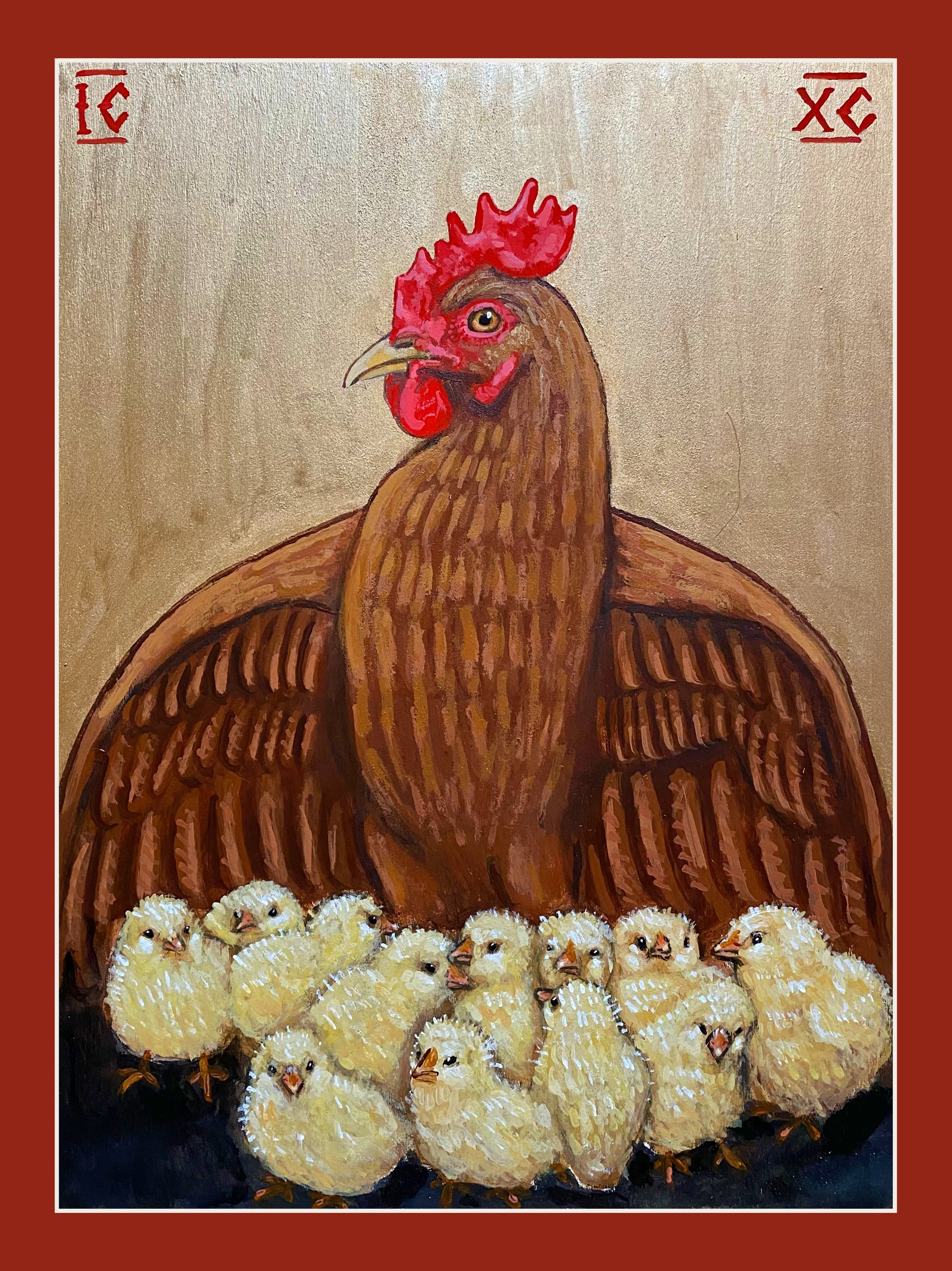
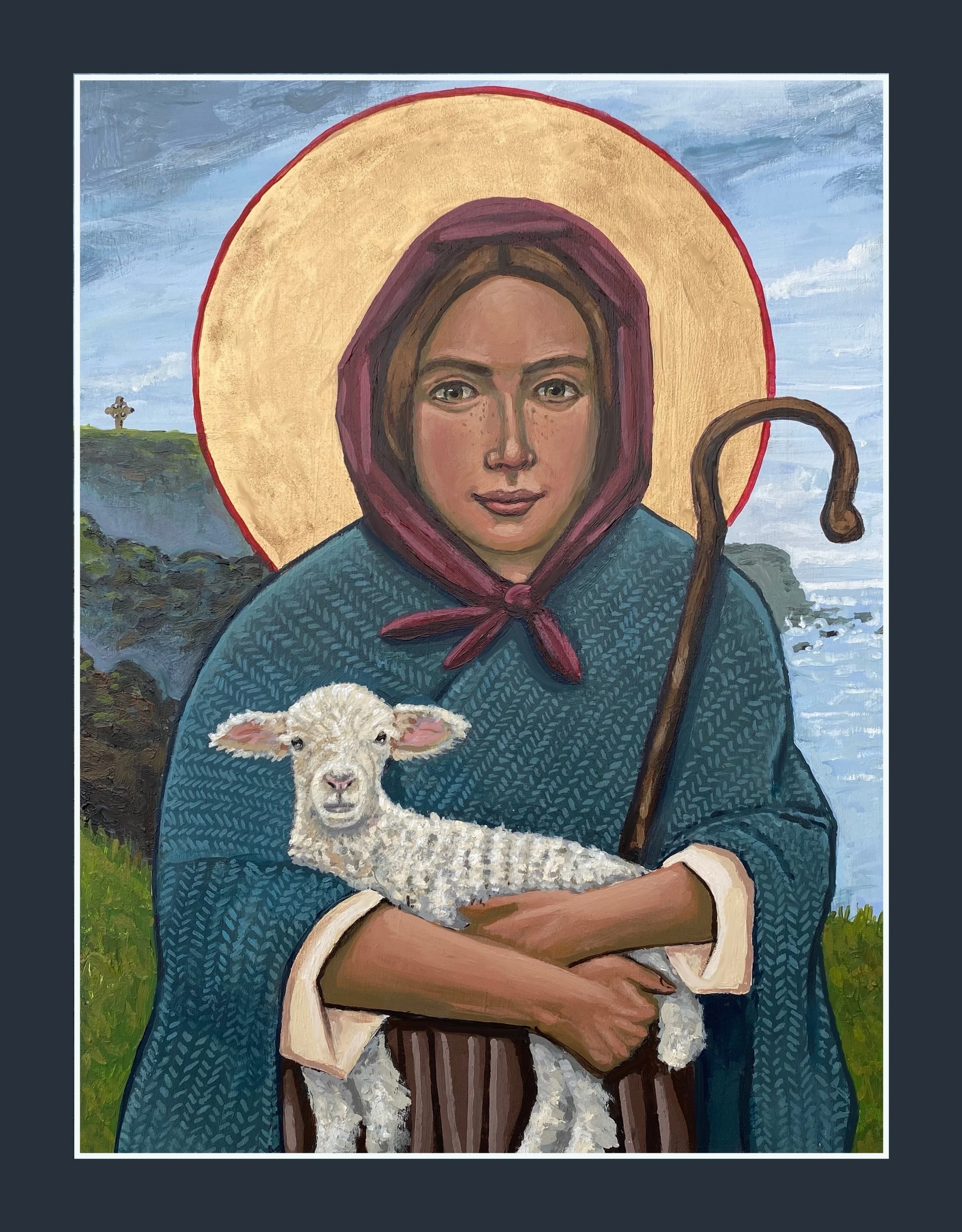
Practice: Look at this icon of Christ as the Mother Hen or The Good Shepherdess by Kelly Latimore. Can you picture yourself safe in the arms of Mother God? I wonder how your child self would have seen these images?
Chapter Two: Remembering Wonder. Redeeming Wounds
Lacy recalling both wounds and wonder from childhood reminded me of the refrain we often sing during worship: “Here is the world. Beautiful and terrible things will happen. Don’t be afraid.” I wonder what that refrain brings up for you? I wonder if there is a connection between wounds and wonder, suffering and mystery, that feels particularly for you? Or, I wonder if that feels untrue for you for any reason? Why or why not?
Near the end of the chapter, Lacy talks about nothing being wasted—not even our wounds. I wonder how we can think about this in a way that honors grief without trying to make too much meaning out of everything. In other words, it’s okay to push back against the idea that everything happens for a reason, and instead, to be honest with ourselves and with God about our feelings of grief. I think of the Godly Play question: “I wonder if we can leave out any part of this story and still have all of the story we need?” I wonder if there is any part of your story you wish you could leave out? Why or why not?
Our earliest experiences are rooted in wonder. The German poet Hermann Hesse wrote, “Much became narrow, what once was wide, much became impoverished, what once was precious” (as quoted in Wolbert et al.). I wonder what was precious for you in childhood? I wonder if you can imagine yourself walking the wide path back to wonder?
Optional practice from Lacy:
“Create an altar. Find a space where you can create a small altar reminding you of God’s generous way and your identity as beloved of God. Place pictures of yourself as a child on your altar. You might also include a candle, a passage of Scripture, or a poem that speaks to you of God’s generous way. Keep it simple and meaningful. Less is more when it comes to altars. Visit this space once a day for at least five minutes. Allow yourself to bask in God’s love for you.”
Intro and Chapter One: Knowing God. Accepting Self.
Lacy identifies the trinity as a “community of Love” and in the introduction, talks about the word “welcome” in terms of being a “wished for guest.” How does it feel to be a wished for guest in the community of Love? How might that influence our reading of scripture in light of God’s desire for the whole world?
What is your earliest memory of God? What is your earliest memory of experiencing Love? Are they the same?
Lacy references the theologian Karl Rahner who said, “We do not have a childhood spirituality and then trade up for an adolescent spirituality and then again trade up for a young adult spirituality and so on. No, Rahner explained, we carry both our childhood selves and our adolescent selves with us into adulthood.. “ - I wonder what your childhood self is teaching you today?
Optional practice:
Reflect on this painting of The Holy Trinity by Ukrainian artist Ivanka Demchuk. Can you picture yourself at the table as a wished for guest? I wonder what it would feel like if the icon were all children? I wonder how the table might look? What the people might be doing?